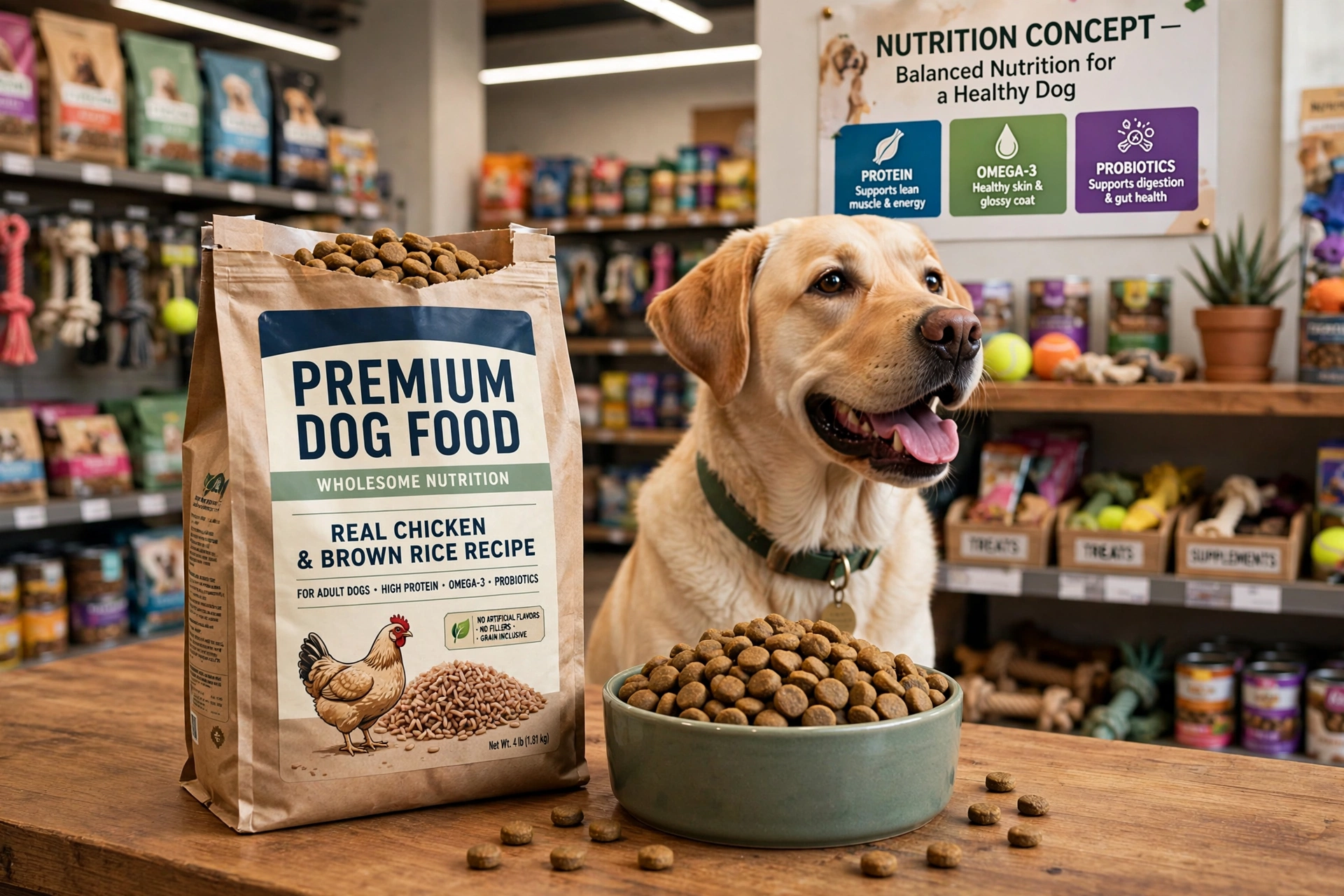
Walk down any pet store aisle and you’ll face a wall of dog food bags — grain-free, raw-coated, limited-ingredient — each claiming to be the healthiest choice. Here’s the reassuring truth: choosing a good dog food is simpler than the industry wants you to believe. This guide gives you the foundation to shop with confidence.
Understanding AAFCO: The Nutritional Safety Net
The Association of American Feed Control Officials (AAFCO) sets nutrient profiles defining “complete and balanced” dog food in the US. Look for the AAFCO statement on the bag. There are two ways food earns it: formulation (recipe calculated to meet profiles) and feeding trials (actually fed to dogs — the stronger standard).
Life-stage designations: “growth” (puppies), “adult maintenance,” “all life stages.” For most dogs, an AAFCO-compliant food matched to the correct life stage is the single most important thing on the label.
How to Read a Dog Food Label
The Ingredient List
- Look for named animal protein (chicken, beef, salmon) in the first few ingredients.
- Watch for ingredient splitting: “peas, pea starch, pea protein” disguises that peas dominate the formula.
- Ignore romance copy: “holistic,” “ancestral,” “human-grade” have no regulated nutritional meaning.
Calorie Content
Look for the kcal/cup statement — foods vary enormously (280 to 500+ kcal/cup). Always portion by calories, not volume.
Matching Food to Life Stage
Puppies
Feed “growth” or “all life stages” formula. Large-breed puppies (expected adult weight over 50 lbs) need large-breed puppy formula specifically — it controls calcium to prevent developmental orthopedic disease. Bringing home a new puppy? Our new puppy checklist covers everything else you’ll need beyond food.
Adult Dogs
Most healthy adults do well on “adult maintenance.” Adjust portions to maintain ideal body condition rather than chasing a “high-performance” label.
Senior Dogs
Around age 7 (large breeds) or 9–10 (small breeds), consider senior formula with joint support and omega-3s.
Wet vs. Dry Food
- Dry kibble: Economical, convenient. The “cleans teeth” claim is overstated.
- Wet food: Higher moisture helps hydration; more palatable for picky eaters.
- Raw/homemade: Can work but carry risks — bacterial contamination and nutritional incompleteness. Work with a veterinary nutritionist, not a blog recipe.
Special Dietary Needs
Food Allergies
True allergies are less common than marketing suggests. Culprits are usually proteins: beef, dairy, chicken. Diagnosis requires a strict 8–12 week elimination trial supervised by your vet. Note: grain-free diets have been associated with a potential link to dilated cardiomyopathy (DCM).
Weight Management
The most common feeding mistake isn’t the wrong brand — it’s feeding too much. Measure with a scale, keep treats under 10% of calories, weigh monthly.
Common Mistakes to Avoid
- Feeding by the bag’s chart alone — adjust to body condition.
- Constant food switching — find a good food and stick with it.
- Free-feeding — destroys portion control and hides appetite changes.
- Over-treating — extras easily add 20–30% more calories.
- Ignoring the transition period — switch gradually over 7–10 days.
- Poor storage — keep in original bag inside airtight container; don’t buy more than 6 weeks’ supply.
Conclusion
Pick an AAFCO-compliant food for the right life stage, from a manufacturer with real nutritional expertise. Feed measured portions, keep treats in check, and let your dog’s body condition — not marketing — be your guide. And if your dog shows worrying symptoms, learn the 10 signs your dog needs a vet visit.
Disclaimer: This article is for general informational purposes only and is not veterinary advice. Consult your veterinarian before making significant diet changes.